False Negative Pregnancy Test: Causes, Retesting & Next Steps
Why a negative home test may not settle the question—and how to retest without guessing.
Short answer: A false negative pregnancy test means the test reads negative even though pregnancy is present. Testing too early, later-than-expected ovulation, diluted urine, or a testing and reading error can all make a result less reliable. Retest with a fresh test at the right time, and do not wait on a home result if you have urgent symptoms.
Home pregnancy tests look for human chorionic gonadotropin (hCG) in urine. A negative result is not automatically a false negative, and symptoms alone cannot prove pregnancy. The useful question is whether the test was taken and read under conditions that could detect hCG yet.

On this page
What does a false negative pregnancy test mean?
A false negative is a negative test result when pregnancy is actually present. It is different from a test that was taken before enough hCG was present to detect, because the early result may become positive later. In everyday use, people often call both situations a false negative; the practical response is to review timing and repeat the test rather than assume one result settles everything.
A correctly read negative test taken at an appropriate time may make pregnancy less likely, but no home test can answer every situation. Check the brand instructions, the expiration date, the reading window, and whether the urine sample was unusually diluted.
| Situation | What it may mean | Reasonable next step |
|---|---|---|
| Negative inside the stated window | Pregnancy may be unlikely, or it may still be too early for the hCG level to register. | Use timing and your cycle history to decide whether to repeat. |
| Negative before a missed period | A later ovulation or early implantation can leave hCG below the test threshold. | Retest after the expected period or after the interval in the instructions. |
| No control line or an error message | The device did not provide a valid negative result. | Use a new test and follow its instructions exactly. |
Common reasons a pregnancy test can be falsely negative
The reason is often timing or sample quality rather than a mysterious failure. These possibilities overlap, so use the pattern of testing and your symptoms instead of trying to diagnose from one strip.
1. The test was taken too early
Urine hCG usually rises after implantation, not immediately after sex. If you test before the expected period or soon after a possible conception date, the amount in urine may be below the test's detection threshold. A negative result can change as hCG rises.
2. Ovulation happened later than expected
Calendar estimates are not always exact. Stress, illness, travel, breastfeeding, stopping hormonal contraception, and naturally variable cycles can shift ovulation. If ovulation was later, the test may also have been taken earlier in the pregnancy than the calendar suggests.
3. The urine sample was diluted
Drinking a large amount of fluid shortly before testing can make urine less concentrated. When you need to repeat an early or uncertain test, following the product instructions and using a concentrated sample such as first-morning urine may reduce one source of uncertainty.
4. The test was used or read incorrectly
Too little or too much urine, an incorrect waiting time, a test placed on an unstable surface, or reading the result after the stated window can make interpretation unreliable. Digital tests can also show an error that should not be treated as negative.
5. The test was expired, damaged, or stored poorly
An expired or damaged test may not perform as intended. Heat, moisture, and a torn packet can also affect a test before use. Check the package and use a fresh, in-date test when the answer matters.
6. A rare clinical interference is being considered
The hook effect is a rare laboratory interference associated with very high hCG or hCG variants. It is not the usual explanation for a negative home test. Do not try home dilution experiments; ask a clinician about confirmation if a negative result conflicts strongly with symptoms, prior results, or clinical findings.
The useful distinction
A negative test can be accurate for the moment it was taken and still be too early to answer the question. Treat the result as time-sensitive evidence, not as a diagnosis based on symptoms alone.
When should you retest after a negative result?
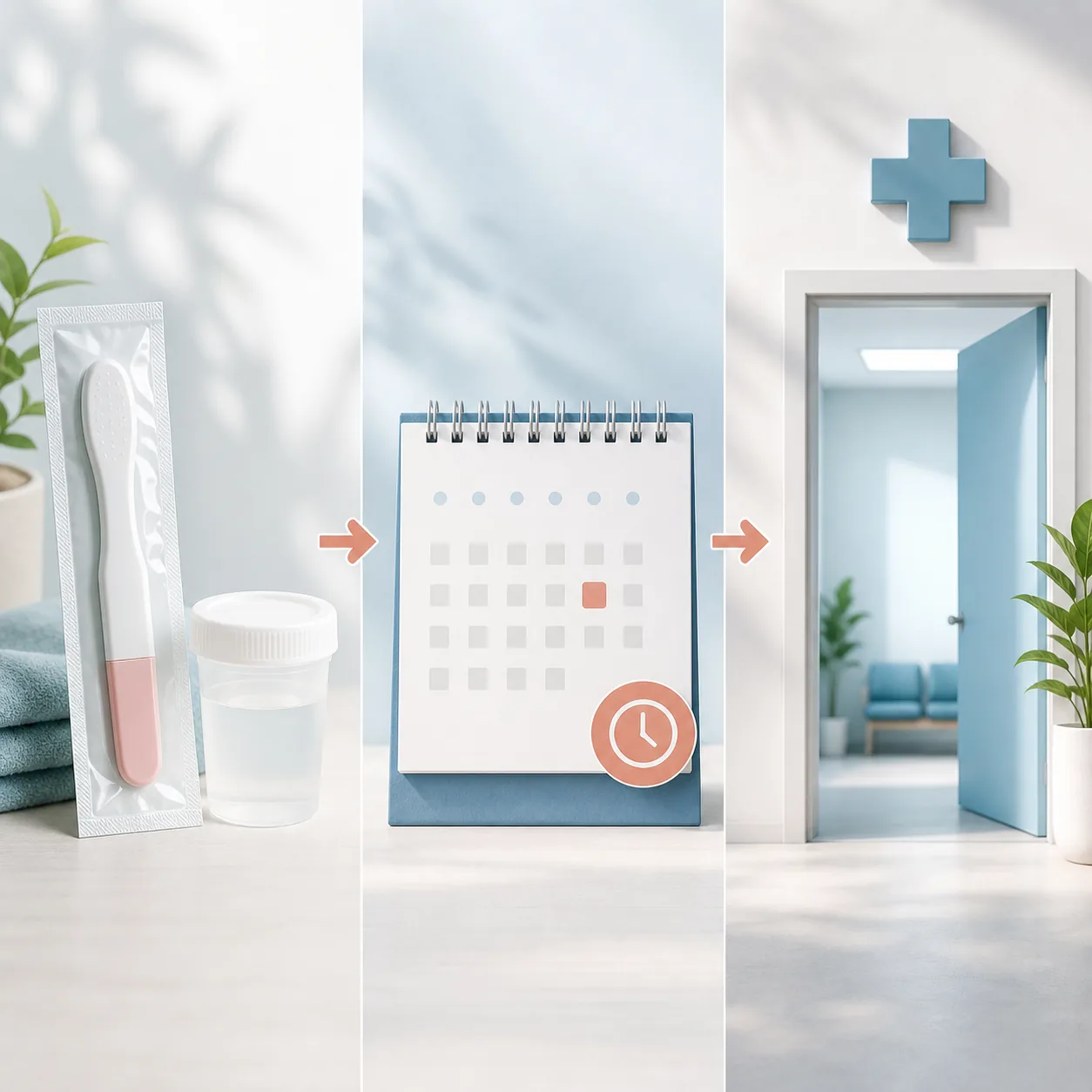
There is no single retest day that fits every cycle. Use the test brand's instructions, the date of your expected period, and whether the first test was early. If pregnancy is still possible, a fresh test after a short interval is more useful than repeating several tests on the same day.
| When the first test was taken | How to interpret it | Next step |
|---|---|---|
| Before the expected period | An early negative is less reassuring because hCG may not yet be detectable in urine. | Repeat after the expected period or follow the product's early-testing guidance. |
| On or after a missed period | A negative is more informative, but timing and urine concentration still matter. | Repeat with a fresh test if the period remains absent or pregnancy is still possible. |
| Repeated negative tests with no period | Pregnancy is not the only cause of a late period, and the cycle may need clinical review. | Contact a clinician for advice, especially if the pattern continues or symptoms are concerning. |
| Severe pain, heavy bleeding, fainting, or marked dizziness | A home test cannot safely explain urgent symptoms. | Seek urgent medical care rather than waiting for another home test. |
- Use a fresh, in-date test. Check the packet, expiration date, and storage condition. Do not reuse a strip or count an error screen as a result.
- Follow the exact instructions. Use the specified sample and read the window at the stated time. Different brands and formats are not interchangeable.
- Record the dates. Note the first test, the expected period, the repeat test, and any bleeding or pain. This makes a clinician conversation more useful.
- Escalate when the answer still matters. A clinician can advise whether another urine test, a blood hCG test, an exam, or a different evaluation is appropriate.
False negative vs negative, invalid, faint-line, and hook-effect results
These terms describe different problems. Calling every unclear test a false negative can send you toward the wrong next step, especially when the control line is missing or the mark appeared after the reading window.
If the physical result is hard to see, the first question is whether the test was valid and read on time. The next question is whether the testing date was early enough to make a repeat useful.
| Term | Main distinction | Best next move |
|---|---|---|
| False negative | The result is negative even though pregnancy may be present, often because timing or sample conditions were not sufficient. | Review timing and retest. |
| Ordinary negative | A valid test is negative and pregnancy may be unlikely at that time. | Follow the cycle and instructions. |
| Invalid test | The control line is missing, the window is blank, or an error appears; it is not a negative result. | Use a new test. |
| Faint or evaporation line | A faint colored line inside the window differs from a colorless or late mark after the reading time. | Read the faint-line guide and retest. |
| Hook effect | A rare interference associated with very high hCG; it is not the usual reason for a negative home test. | Ask a clinician about confirmation. |
When should you contact a clinician?
Contact a healthcare professional when repeated results and your cycle do not line up, when you need a definite answer, or when you have risk factors or symptoms that a home test cannot assess.
- Seek urgent care now for severe or one-sided abdominal or pelvic pain. Also seek urgent help for heavy bleeding, fainting, severe dizziness, shoulder pain with abdominal symptoms, trouble breathing, or rapidly worsening symptoms. These signs need assessment even if a home test is negative.
- Arrange medical advice for persistent uncertainty. A period that remains absent after repeat testing, repeated negative tests with ongoing pregnancy possibility, or symptoms that continue to worry you are reasonable reasons to contact a clinician.
- Ask about confirmation when medication or a health condition matters. Tell the clinician about fertility treatment, recent pregnancy, medicines, irregular cycles, and the dates and brands of tests used. Do not stop prescribed medicines based only on an online guide.
For general pregnancy-test and warning-sign information, see Office on Women’s Health, MedlinePlus.
What an AI pregnancy-test photo checker can and cannot do
Our AI pregnancy test checker can help you inspect whether a visible line, control line, or photo-quality problem is present. It cannot measure urine hCG, know when ovulation happened, or rule out a false negative.
For the medical next step, pair a photo review with the when-to-test guide, the negative-test and no-period guide, the faint-line guide, and the hook-effect guide. A clear photo is not a substitute for a fresh test or clinical confirmation.
FAQ about false negative pregnancy tests
Medical references
For background on home pregnancy tests, timing, and safe follow-up, see FDA home-use pregnancy test information, Office on Women’s Health pregnancy-test guidance, MedlinePlus pregnancy-test information, and NHS pregnancy-test guidance. These sources explain why instructions, timing, urine concentration, and follow-up matter.
Bottom line
A false negative pregnancy test is possible, especially when the test is early or the sample and instructions were not ideal. Check the timing, use a fresh test, retest when it can answer the question more reliably, and seek clinical advice when the period remains absent or the result conflicts with your symptoms. Severe pain, heavy bleeding, fainting, or rapidly worsening symptoms need urgent care regardless of the home result.