Faint Line vs Evaporation Line: How to Tell the Difference
A faint mark can be a possible early positive, an evaporation line, or an unclear result. Use the reading window, dye color, line shape, a fresh photo, and a repeat test before deciding what it means.
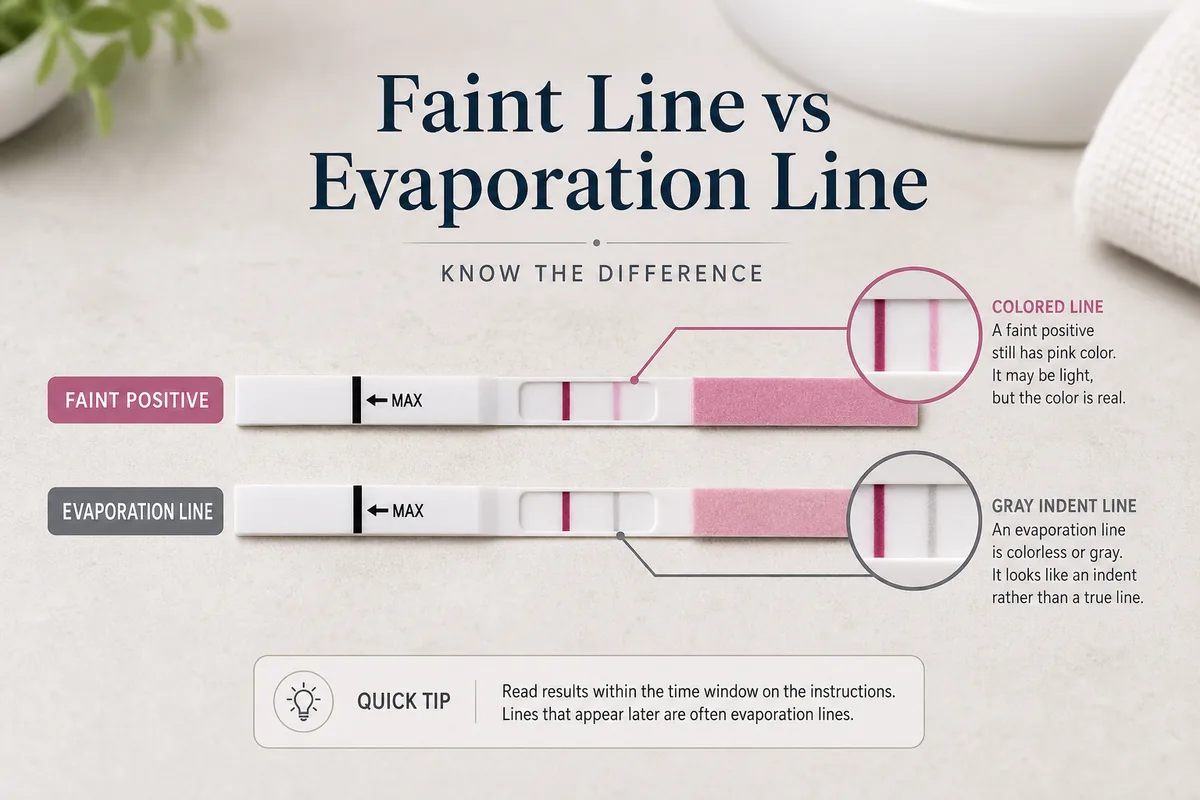
Quick answer: a faint positive line usually has pink or blue dye, appears in the correct test area, and shows up within the brand's stated reading window. An evaporation line is usually gray, colorless, or indent-like and often appears after the test dries. If you are unsure, take another test in about 48 hours or ask a healthcare professional for confirmation.
This article is for people comparing a faint line vs evaporation line with a possible evaporation line. It does not replace the instructions that came with your test, a blood hCG test, or medical advice. It is meant to help you make the next practical decision: read now, photograph clearly, retest, or get clinical confirmation.
Contents
Faint Positive vs Evaporation Line: The Core Difference
The biggest difference is not only whether you see a line. It is when the line appeared, whether it has dye color, and whether it sits exactly where the test line should be. A true faint positive is caused by hCG reacting with the test strip. An evaporation line is a drying mark that can appear as urine evaporates from the test window. This is why many people search for evaporation line vs faint positive examples before deciding whether to retest.
| Check | Faint Positive Line | Evaporation Line |
|---|---|---|
| Timing | Appears within the test's stated reading window, often 3-5 minutes depending on brand. | Often appears after the reading window, once the test begins to dry. |
| Color | Usually pink or blue, matching the test dye. | Usually gray, colorless, shadow-like, or indent-like. |
| Position | Located exactly where the test line should appear. | May sit in the test-line groove but lacks dye color. |
| Change over time | May become darker on a new test after 48 hours if hCG rises. | Does not reflect rising hCG and may only appear as the strip dries. |
| Best next step | Retest with first morning urine or confirm with a clinician. | Ignore late-read results and repeat with a new test inside the correct window. |
7 Ways to Tell If It Is a Faint Line or Evaporation Line
1. Read the test inside the exact time window
Read a faint line vs evaporation line only inside the test’s stated time window. A colored mark that appears on time is more meaningful than a gray shadow noticed after the strip dries. If you are comparing an evaporation line vs faint positive strip test, use a fresh test and the package instructions rather than an old dried strip.
2. Look for dye color, not just a shadow
A faint line checker should focus on color. Pink-dye tests usually produce pink lines; blue-dye tests usually produce blue lines. If the mark looks gray, silver, or like a dent with no color, it is more consistent with an evaporation line or indent line.
3. Compare the line width and placement
A true positive line usually has a similar width and alignment to the control line, although it may be much lighter. If the mark is off-center, extremely thin, broken, or visible only at one angle, treat it cautiously and retest.
4. Do not judge a dried test
Dried tests are a common source of confusion. A result photographed 20 minutes, 1 hour, or the next day can look very different from the valid read time. If you only noticed the mark later, use a new test rather than trying to rescue the old result.
5. Retest after hCG has time to rise
In early pregnancy, hCG often rises enough over a couple of days for a line to become easier to see, though patterns vary. If the first test is unclear, retesting in about 48 hours with first morning urine is usually more useful than repeatedly studying the same strip.
6. Check whether you tested too early
Testing before a missed period increases the chance of a very faint line or a false negative. If your period is not due yet, a faint mark may be hard to interpret. Waiting until the day of the expected period or after a missed period generally gives home tests a better chance to detect hCG.
7. Use photo review as support, not a diagnosis
An online pregnancy test line reader can help when your eyes keep second-guessing a faint result. It may highlight contrast, line color, and the likely test area. Still, a photo tool cannot know your timing, cycle history, medication use, or whether the test was read according to the package instructions.
How to Photograph a Pregnancy Test for a Faint Line Detector
If you plan to use a faint line detector or ask someone to help read your test photo, photo quality matters. A blurry or shadowed image can make an evaporation line look darker or hide a real faint positive.
- Take the photo during the valid reading window. Do not wait until the test dries.
- Use bright natural light. Place the test near a window, but avoid harsh glare on the result window.
- Keep the test flat. Angled photos can create shadows in the test-line groove.
- Focus on the result window. The control line and possible test line should both be sharp.
- Avoid filters and heavy edits. Inverting, sharpening, or increasing contrast can be useful for exploration, but it can also exaggerate marks that are not true dye lines.
- Include the whole test window. Cropping too tightly removes context such as the control line and line spacing.
Practical tip
If you upload a photo to our free AI pregnancy test checker, use a fresh photo taken inside the brand's reading window. That gives the AI more useful visual information than a dried-test photo.

When to Retest, When to Trust the Result, and When to Ask for Help
If the line appeared on time and has dye color, treat it as a possible positive and retest soon. If the line appeared late or looks gray, treat it as unclear and repeat with a new test. If you need a definitive answer for medication, fertility treatment, pregnancy symptoms, pain, bleeding, or missed periods, contact a healthcare professional.
Use this decision guide
| Situation | Most Useful Next Step |
|---|---|
| Colored faint line within the time window | Retest in about 48 hours or confirm with a healthcare professional. |
| Gray line after the test dried | Do not count the dried result; repeat with a new test and read on time. |
| No line but period is late | Retest with first morning urine or ask about blood hCG testing. |
| Pain, heavy bleeding, dizziness, or concerning symptoms | Seek medical care promptly instead of relying on home interpretation. |
For general background, the FDA home-use pregnancy test guidance explains that home tests detect hCG, while the Mayo Clinic and Cleveland Clinic provide practical notes on timing, false negatives, and follow-up.
Should You Use a Pregnancy Test Photo Checker?
A photo checker is most helpful when your main problem is visual: a very light line, a shadow, glare, or uncertainty about whether the mark has dye color. It is less helpful when the problem is timing, testing too early, expired tests, diluted urine, or symptoms that need medical review. If you need a second look, use the free AI pregnancy test checker with a clear photo taken inside the valid reading window.
Use our AI tool as a second look, not as the final authority. If the checker says the image looks positive but the test was read late, retest. If the checker says unclear but your period is late, retest or ask for a clinical test. The strongest answer usually comes from combining the package instructions, a fresh test, and medical confirmation when needed.
If the timing is still unclear, read when to test after sex and for a late period with a negative result, see the negative-test guide.
FAQ About Faint Lines and Evaporation Lines
Summary
A faint positive line usually appears on time, has dye color, and sits in the correct test-line area. An evaporation line usually appears late, looks gray or colorless, and becomes more noticeable as the test dries. When in doubt, use a fresh test, read it on time, photograph it clearly, and confirm medically when the answer affects your health decisions.