Hook Effect Pregnancy Test: Why High hCG Can Cause a False Negative
A rare testing limitation explained without turning every negative result into a hook-effect diagnosis.
Quick answer: The hook effect is a rare laboratory or pregnancy-test interference in which an extremely high concentration of hCG prevents the test's antibodies from forming the signal-producing sandwich. The result may look falsely low or negative even though hCG is present.
Most negative home tests are not caused by the hook effect. Testing too early, using diluted urine, missing the reading window, or using a damaged or expired test is much more common. If a result conflicts with a missed period, prior positive result, significant symptoms, or a clinician's findings, do not rely on repeated home experiments; ask a healthcare professional how to confirm the result.
On this page
Hook Effect Pregnancy Test: The Essential Facts
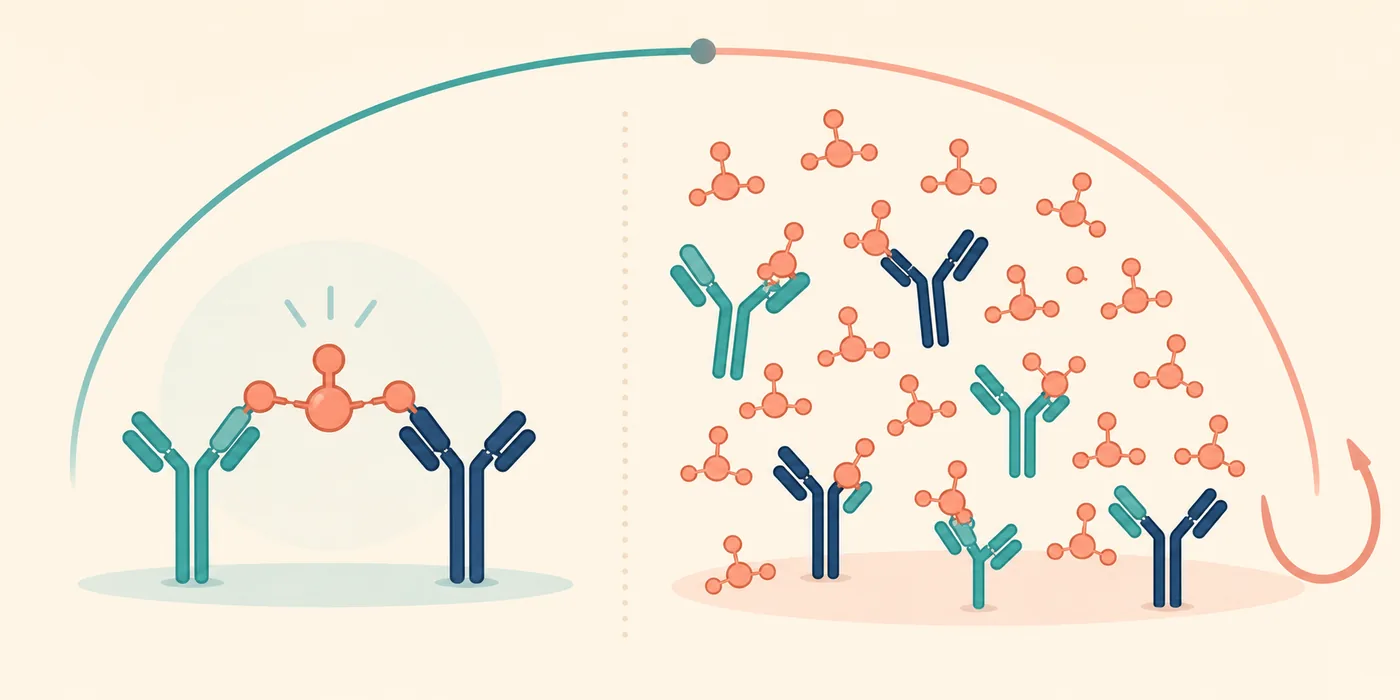
Pregnancy tests are immunoassays: they use antibodies to recognize human chorionic gonadotropin, or hCG. In the expected measuring range, hCG helps create an antibody-hCG-antibody complex that produces a visible line or laboratory signal. In a high-dose hook effect, an unusually large amount of analyte can occupy the antibodies separately, so fewer complete complexes form and the signal becomes unexpectedly weak.
The term also gets used loosely online. A test line becoming lighter later in pregnancy, a negative test after drinking a lot of fluid, and a negative test taken before the missed period are not proof of a hook effect. Different products recognize different hCG forms and have different safeguards, which is why a clinician and laboratory should interpret a genuinely inconsistent result.
| Situation | More likely explanation | Practical next step |
|---|---|---|
| Negative before or near the expected period | hCG may still be below the test threshold | Repeat at the instructed time, often after 48–72 hours |
| Negative after very diluted urine | Urine concentration may be too low | Use a fresh test exactly as directed; first-morning urine may help when testing early |
| Negative after a previous positive or with strong clinical evidence | The result needs professional confirmation; hook effect is one rare possibility | Contact a clinician or laboratory rather than repeatedly changing the sample |
| Severe pain, fainting, or heavy bleeding with any result | A potentially urgent condition cannot be ruled out at home | Seek urgent medical assessment |
How Does the High-Dose Hook Effect Work?
Many urine and serum pregnancy tests use a two-site or sandwich design. One antibody captures hCG and another antibody supplies the detectable signal. When the amount and form of hCG fit the assay's working range, both antibodies bind to the same target and a positive signal appears.
At an extreme analyte concentration, hCG can saturate the capture and detection antibodies independently. That reduces the number of complete sandwiches, so the instrument or strip may report a value that is lower than expected. When signal is plotted against concentration, the curve can rise and then bend downward like a hook, which gives the phenomenon its name. Urine adds another complication: hCG exists in several molecular forms, and their proportions change during pregnancy. Research on point-of-care urine testing has described a related variant or hook-like effect involving the beta-core fragment. A product may recognize some forms better than others, so not every unexpected result has the same mechanism.
- Normal range: Enough complete antibody-hCG-antibody complexes form to produce a signal.
- Extreme excess: Separate antibody sites may become occupied without forming the signal-producing bridge.
- Assay dependent: Thresholds and susceptibility vary by product, hCG form, specimen, and laboratory method.
How Common Is the Hook Effect in Pregnancy Tests?
It is rare. Published medical literature consists largely of laboratory investigations and case reports, including unusual clinical settings such as very high hCG concentrations, multiple gestation, or gestational trophoblastic disease. Those reports prove that interference can occur; they do not mean it is a common explanation for a home negative result.
Modern assays may include design changes intended to reduce high-dose interference, and manufacturers specify different tested ranges. There is no single week of pregnancy or universal hCG number at which every home test turns negative. Claims that all tests fail after five, six, or eight weeks oversimplify the evidence. For everyday testing, timing remains the more important issue. The FDA notes that urine hCG becomes detectable after implantation and that accuracy depends on timing, instructions, and interpretation. A negative result taken early is therefore much more plausibly explained by insufficient detectable hCG than by too much hCG.
When Might a Clinician Consider a Hook Effect?
The clue is a mismatch, not a particular symptom. A clinician may consider assay interference when a qualitative urine or blood result is negative or unexpectedly low but the broader clinical picture strongly suggests pregnancy or very high hCG. Examples in the literature include a result that conflicts with imaging, a markedly enlarged uterus, a prior documented positive result, or findings that raise concern for gestational trophoblastic disease.
Twins are often mentioned online because multiple pregnancy can be associated with higher hCG, but a home test cannot diagnose twins and a negative test does not imply twins. Most twin pregnancies still produce a positive home test. Likewise, nausea, breast tenderness, fatigue, or a missed period are nonspecific and cannot identify hook-effect pregnancy test interference. A test line that becomes lighter is also not a reliable monitor of pregnancy progression. Line darkness changes with urine concentration, test batch, lighting, timing, and the assay itself. Once pregnancy is confirmed, serial home strips are not a substitute for clinical evaluation when there is a medical concern.
| Finding | What it can tell you | What it cannot prove |
|---|---|---|
| Previous positive, later negative | Results are inconsistent and deserve context | Hook effect, miscarriage, or pregnancy status by itself |
| Very dark then lighter test line | The optical result changed | Whether hCG rose or fell, or whether pregnancy is healthy |
| Missed period and symptoms | Pregnancy remains one possibility | That high hCG caused a false negative |
Hook Effect vs Common Causes of a False-Negative Pregnancy Test
Testing too soon is the leading practical explanation. Ovulation and implantation do not always occur on the calendar day predicted by an app, so a test can be early even when a period seems late. Diluted urine can lower the concentration presented to the strip, especially early in pregnancy. Incorrect dipping time, too little or too much urine, reading outside the instructed window, expired materials, heat or moisture damage, and a missing control line can also make a result unreliable.
An invalid test is different from a negative test. If the control indicator does not appear, the test did not work and should be repeated with a new device. An evaporation line is also different: it is a visual change seen after the reading window, not a high-dose antibody interference. Medical causes of a missed period are broader still. Stress, illness, changes in weight or exercise, breastfeeding, perimenopause, polycystic ovary syndrome, thyroid conditions, and other factors can delay ovulation or menstruation. A persistent missed period with repeated negative tests warrants clinical advice rather than assuming either pregnancy or the hook effect.
What to Do When a Pregnancy Test Result Does Not Make Sense
First, check the ordinary variables: confirm the expiration date, instructions, control indicator, reading window, and testing date. If the test was early and there are no urgent symptoms, repeat it after the interval in the instructions or after 48–72 hours. Avoid drinking excessive fluid immediately before an early urine test.
Second, contact a healthcare professional when results remain inconsistent, a period stays absent, a previously positive test becomes negative, or symptoms are concerning. A clinician may use a quantitative serum hCG test, repeat testing on a different assay, communicate with the laboratory about possible interference, or use ultrasound when appropriate. The correct choice depends on timing and clinical context.
Third, treat warning symptoms independently of the strip. Severe or one-sided pelvic or abdominal pain, shoulder pain, fainting, marked dizziness, heavy bleeding, fever, or feeling acutely unwell requires prompt assessment. A negative home pregnancy test cannot safely exclude an ectopic pregnancy or another urgent cause in a symptomatic person.
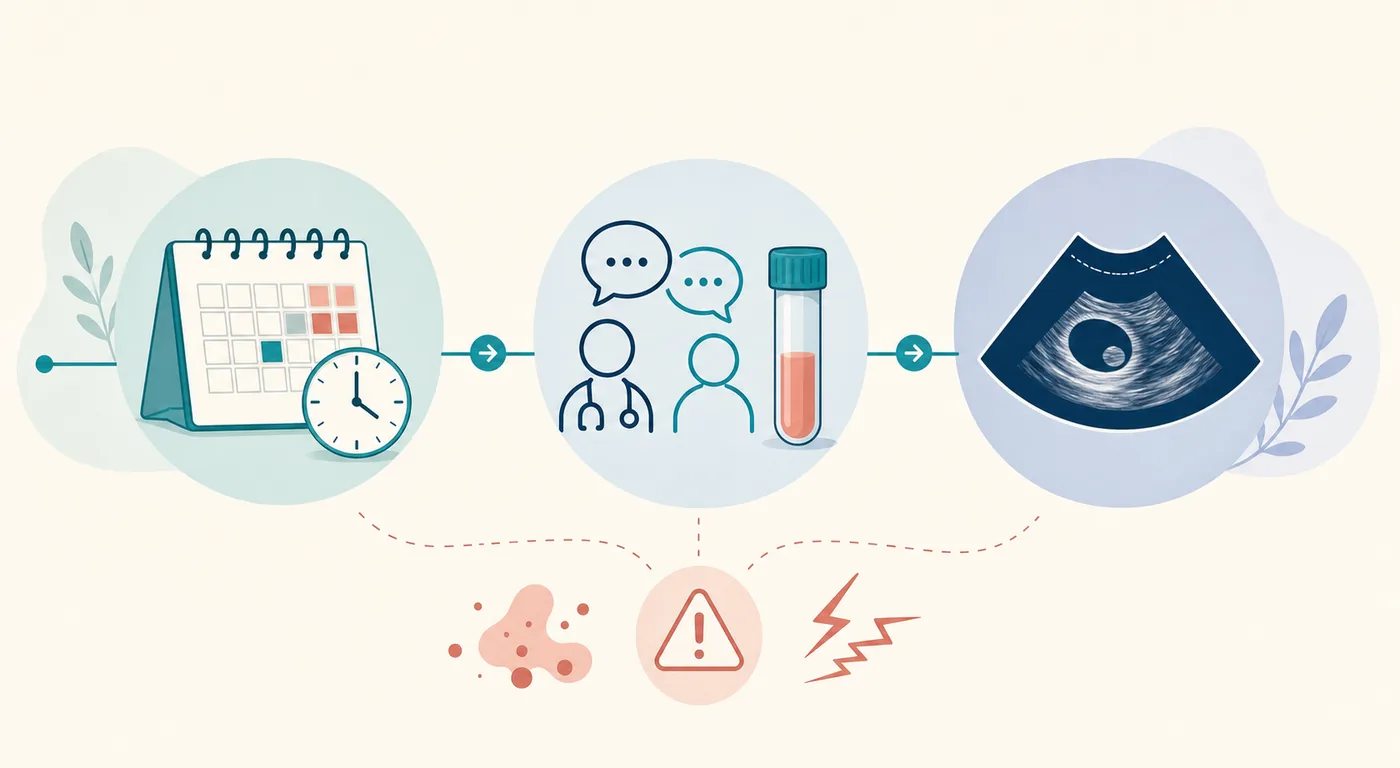
- Retest routinely: When the first test was early, valid, and there are no warning symptoms.
- Call a clinician: When results conflict, uncertainty persists, or a prior positive becomes negative.
- Seek urgent care: For severe pain, fainting, major dizziness, heavy bleeding, or rapid deterioration.
Should You Dilute Urine to Test for the Hook Effect?
Laboratory publications describe dilution as one way trained professionals can investigate suspected assay interference. That does not make a kitchen dilution experiment a diagnostic test. There is no validated home ratio, tap water can introduce uncontrolled variables, and changing a sample may move it outside the manufacturer's instructions.
A darker line after home dilution does not confirm the hook effect, twins, or a healthy pregnancy. A lighter line does not show falling hCG. If the result matters medically, use the device as directed and ask a clinician or laboratory to choose an appropriate confirmation method. The same caution applies to comparing many test brands or photographing strips under different lighting. Those experiments can increase anxiety without providing a quantitative or clinically interpretable result. The useful goal is not to prove an internet theory; it is to establish whether pregnancy is present and whether symptoms need care.
Frequently Asked Questions
Medical Sources
This guide uses primary research and current testing guidance from:
Bottom Line
A hook effect pregnancy test result is possible but rare. It occurs when an assay is overwhelmed or disrupted by very high hCG or an hCG variant, not simply because a test was negative. Check timing and instructions first, avoid treating line darkness or home dilution as diagnosis, and obtain professional confirmation when the result conflicts with prior tests, symptoms, or clinical findings.