How Soon After Sex Can You Take a Pregnancy Test?
Testing too early is a common reason for a false negative. This guide separates the earliest possible timing from the more dependable time to test and explains what to do after a negative result.
Quick answer: you usually cannot get a reliable pregnancy test result just a day or two after sex. Most people need to wait until after implantation and enough hCG has built up, which means testing around the day your period is due is usually more reliable. If you test earlier, a negative result can still be too soon.
This article is for people asking how soon after sex can you take a pregnancy test because they want a realistic timeline, not guesswork. It does not replace medical care, blood hCG testing, or urgent evaluation for pain, heavy bleeding, or dizziness.
Contents
Pregnancy Test Timing After Sex: What Happens First?
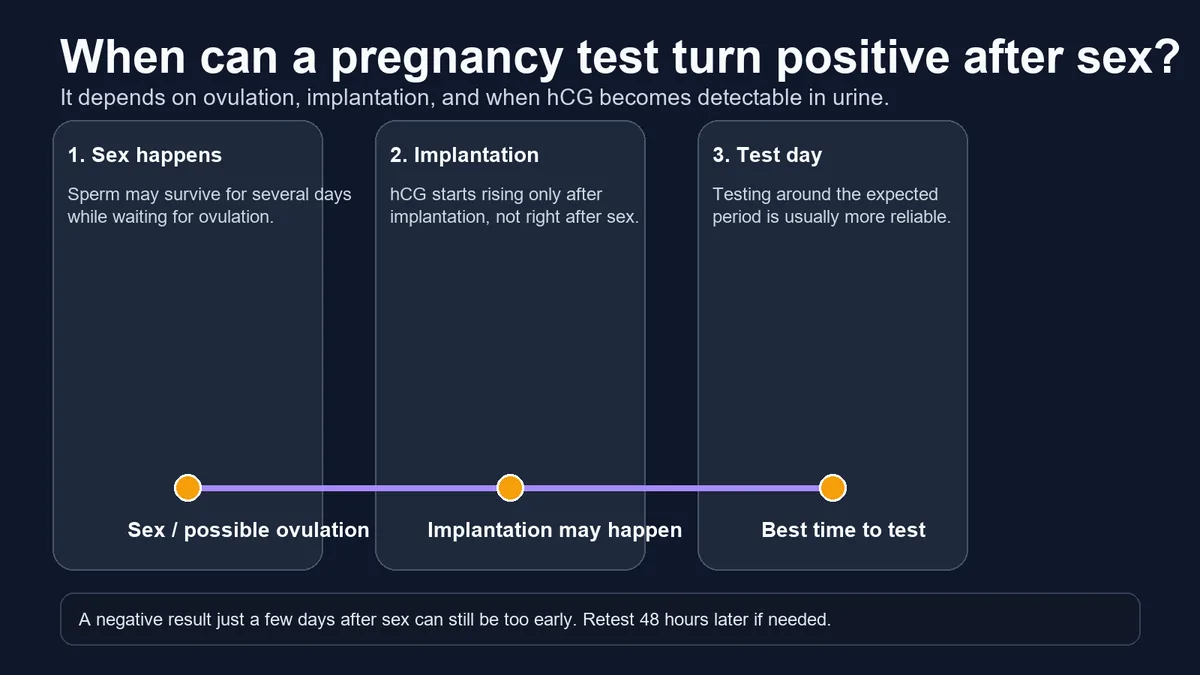
The main mistake is assuming sex and a positive test can happen almost back-to-back. In reality, the body needs time for ovulation, possible fertilization, implantation, and then hCG production.
| Stage | What your body is doing | What the pregnancy test can do |
|---|---|---|
| 0 to 1 day after sex | Sperm may still be traveling and waiting if ovulation has not happened yet. | A urine pregnancy test is too early to help. |
| Around ovulation | Fertilization can happen only if a sperm meets an egg during the fertile window. | Still too early for a pregnancy test. |
| About 6 to 12 days after ovulation | Implantation may happen, and hCG starts building after implantation. | Some very early tests may detect pregnancy near the end of this window, but false negatives are common. |
| Around the expected period | hCG is more likely to be high enough for a urine test to detect. | This is usually the more reliable time to test. |
| 48 hours after an early negative | If hCG was still low before, it may now be easier to detect. | Retesting is often more useful than overanalyzing the first strip. |
So When Can You Take a Pregnancy Test Most Reliably?
If you are asking how soon you can take a pregnancy test, the shortest honest answer is that a test just a few days after sex is usually too early to settle the question. Testing on or after the day your period is due is generally more useful, because hCG rises after implantation. If you test earlier, treat a negative result as potentially inconclusive and plan a repeat test.
If you know when you ovulated, timing the test from ovulation is more accurate than timing from sex alone. That is because sex can happen days before ovulation, and sperm can survive in the reproductive tract for several days. For many people, the question is really when to test after ovulation or after a missed period, not just after intercourse.
Practical rule
If you are tempted to test very early, do it only if you understand that a negative result may still be inconclusive. If you want a more dependable answer, wait until the expected period date or later.
What Changes How Soon a Pregnancy Test Can Turn Positive?
1. When ovulation actually happened
If sex happened several days before ovulation, you need to count from ovulation and implantation, not from the day of sex alone. That is why two people who had sex on the same calendar day can get very different test timing.
2. Implantation timing
Implantation does not happen immediately. Until implantation happens, hCG has not started rising in the way urine tests need. A test taken before this stage cannot become positive no matter how sensitive the brand is.
3. Test sensitivity and brand differences
Some early-result tests may detect lower levels of hCG than others, but they still cannot overcome biology. A more sensitive brand may shorten the window slightly, yet it cannot create hCG before your body has produced it.
4. Urine concentration
First morning urine is often more concentrated, which can help when you are testing early. Drinking a lot of water right before testing can make hCG harder to detect and increase the chance of a false negative.
5. Irregular cycles or uncertain dates
If your cycles are irregular, counting from a predicted period can be less reliable. In that case, retesting every 48 hours after an initial negative may be more practical than trusting one early result.
Irregular cycles or unknown ovulation
If you do not know when you ovulated, counting only from sex can be misleading. Test on the day your period is expected, repeat 48 to 72 hours later if negative, or use 21 days after sex as a practical checkpoint when cycle timing is uncertain.
If the Result Is Negative, Does That Mean You Are Not Pregnant?
Not necessarily. A negative test can mean you are not pregnant, but it can also mean you tested before hCG was detectable. The closer you are to the expected period date, the more useful the result becomes.
| Result situation | What it may mean | Best next step |
|---|---|---|
| Negative a few days after sex | Usually too early to rely on. | Wait and retest closer to your expected period. |
| Negative on the day your period is due | May be a true negative, but ovulation timing could still be off. | Retest in 48 hours if your period does not start. |
| Negative after a missed period | More likely to be accurate, though exceptions still happen. | Retest or ask about a blood test if symptoms or concern continue. |
| Faint or unclear line | Could be an early positive, an evaporation line, or a hard-to-read photo. | Retest with first morning urine and compare with our faint-line guide. |
General medical guidance from Mayo Clinic, Cleveland Clinic and the Office on Women's Health all support the same core point: testing too early can produce false negatives.
Best Way to Take the Test If You Want the Clearest Result
- Wait until the expected period if you can. This reduces the risk of testing before hCG is detectable.
- Use first morning urine for early testing. It is often more concentrated and can make faint positives easier to detect.
- Read the result inside the brand's time window. Late-read lines can create confusion and should not be trusted the same way.
- Retest after 48 hours if the first result is negative or unclear. A small delay is often more informative than trying multiple tests on the same day.
- Seek medical care for pain, heavy bleeding, dizziness, or one-sided pelvic pain. Those symptoms should not be managed by home testing alone.
Why first morning urine helps
When hCG is still low, concentrated urine can make the difference between an invisible line and a visible early positive.
What To Do After a Negative Pregnancy Test
If the test is negative but your period is not here yet, do not assume the question is closed. The best next step depends on how early you tested, whether you know your ovulation timing, and whether you have symptoms.
If your period stays late, symptoms continue, or timing is uncertain, a repeat urine test or blood hCG test can give a clearer answer than repeatedly staring at the first strip.
| Situation | Recommended action |
|---|---|
| Tested less than 10 days after possible ovulation | Assume it may be too early and test again later. |
| Tested on expected period day and got negative | Wait 48 hours and repeat if bleeding has not started. |
| Missed period, negative result, ongoing symptoms | Consider repeat urine testing or ask a clinician about blood hCG. |
| Pain, fainting, heavy bleeding, severe concern | Get medical evaluation promptly. |
Can an AI Pregnancy Test Checker Help?
Yes, a free AI pregnancy test checker can help if you already took a test and want a second look at whether a line is visible in the photo. It is useful for image review, but it does not replace proper timing.
If your result is faint, also read our faint line vs evaporation line guide and, if your line is dramatically dark, the dye stealer pregnancy test guide so you can interpret the photo with the right context.
FAQ About Pregnancy Test Timing After Sex
Summary
If you are asking how soon after sex you can take a pregnancy test, the key is that pregnancy tests detect hCG, not sex itself. Testing too early often leads to false negatives. For a more reliable answer, wait until the day your period is due or later, use first morning urine if you are testing early, and retest in 48 hours if the result is negative or unclear.