Negative Pregnancy Test but No Period: What to Do Next
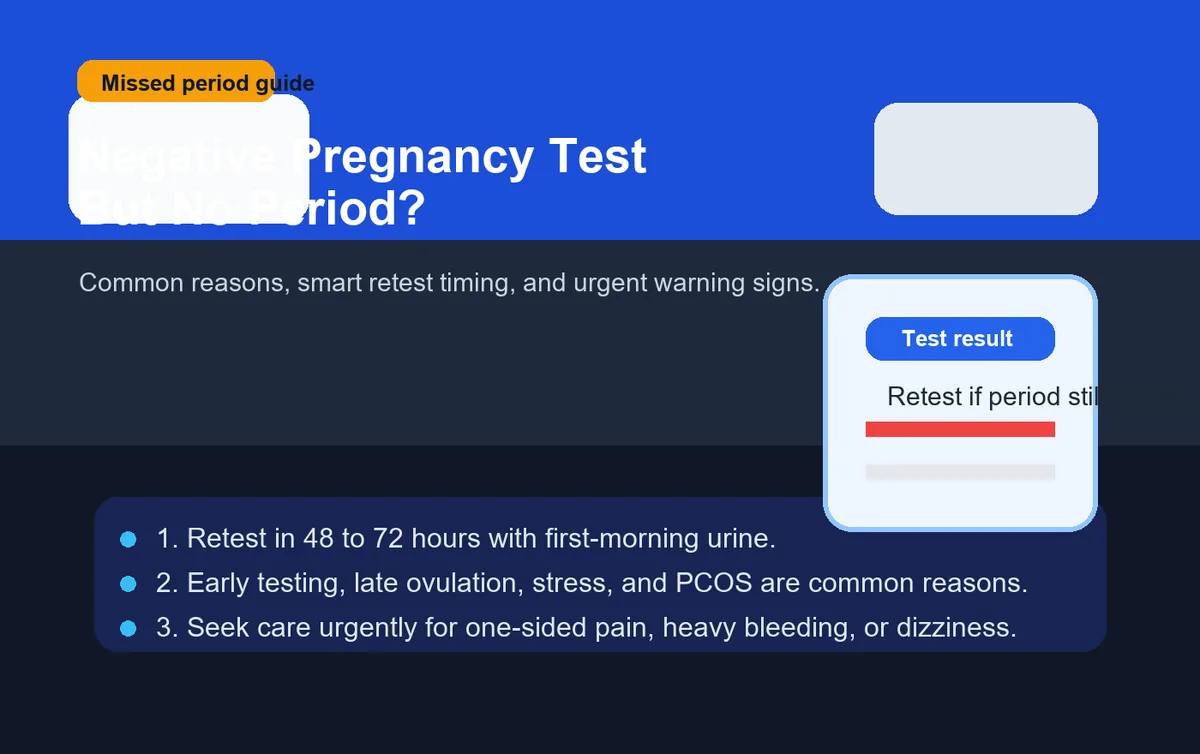
A negative result with no period can reflect early testing, late ovulation, or a delayed cycle. Use timing, symptoms, and repeat testing to choose your next step.
Quick answer: a negative pregnancy test with no period often happens because the test was taken too early, ovulation happened later than expected, or the cycle was delayed by stress, illness, travel, weight change, breastfeeding, or hormone-related conditions such as PCOS or thyroid disease. Pregnancy is still possible if hCG was not yet high enough to detect.
This guide is for people searching for negative pregnancy test but no period and related questions such as pregnancy symptoms but negative test, late period negative pregnancy test, or false negative pregnancy test. It is educational and does not replace medical advice.
Contents
Why Can You Be Late and Still Test Negative?
The most common explanation is timing. Many people assume ovulation always happens in the middle of the cycle, but that is not how real cycles work. If ovulation happened later, implantation also happened later, and the amount of hCG in urine may still be too low for a home test.
Testing before hCG has risen enough
Even sensitive tests can miss early pregnancy if you test before or right after the expected period date. That is why clinicians often recommend retesting 48 to 72 hours later if the period still has not started.
Late ovulation or an unusually long cycle
Travel, stress, illness, poor sleep, intense exercise, and sudden weight changes can shift ovulation. If the egg was released later than usual, your calendar may say your period is late even though your body is simply on a delayed timeline.
Diluted urine or test sensitivity differences
A negative test in the afternoon can happen even if an early-morning test would have been faintly positive. Drinking a lot of fluid, using a less sensitive brand, or reading the result outside the instructions can all reduce reliability.
A non-pregnancy cause of missed periods
Stress, breastfeeding, new hormonal contraception, PCOS, thyroid disorders, perimenopause, and some medications can delay or stop periods without pregnancy.
When Should You Retest After a Negative Pregnancy Test?
Use a second test strategically instead of repeating multiple times in the same day. The best retest timing depends on how late your period is and whether your symptoms are increasing.
| Situation | What it may mean | Best next step |
|---|---|---|
| 1 to 2 days late, test negative | You may have tested before enough hCG was present, or your cycle may be delayed. | Wait 48 to 72 hours and retest with first-morning urine. |
| About 1 week late, test still negative | Pregnancy is still possible, but cycle irregularity becomes more likely. | Retest once more and consider a clinician visit or blood hCG test. |
| Symptoms feel stronger but urine test is negative | Symptoms are not pregnancy-specific, and a urine test may still be early. | Review timing, retest correctly, and seek medical advice if symptoms worsen. |
| Severe pain, fainting, heavy bleeding, one-sided pelvic pain | These are not wait-and-see symptoms. | Seek urgent medical care immediately. |
| No period for more than 6 weeks with repeated negatives | A hormonal or cycle disorder becomes more likely than a timing issue alone. | Arrange a medical evaluation for pregnancy confirmation and cycle assessment. |
Common Causes of a Missed Period When the Test Is Negative
Top SERP pages consistently cover early testing, stress, and hormonal conditions. The missing piece for many readers is practical sorting: which causes are common, which are urgent, and which justify planned follow-up rather than panic.
Early testing and false negatives
A false negative pregnancy test means pregnancy may be present but hCG is still below the test's detection threshold. Testing before the expected period, using diluted urine, or misreading the instructions can all make a negative result less conclusive. If your period is still missing, repeat the test after 48 to 72 hours instead of treating one negative test as final.
Stress, travel, sleep disruption, or intense exercise
The menstrual cycle depends on hormone signals between the brain and ovaries. Major routine changes can temporarily delay ovulation, which delays the period even if you are not pregnant.
PCOS, thyroid disease, or other hormone conditions
These conditions can make cycles unpredictable, very long, or absent for months. If missed or irregular periods are a pattern rather than a one-time event, this should move higher on the list.
Breastfeeding, recent pregnancy, or birth control changes
After childbirth, miscarriage, emergency contraception, or starting and stopping hormonal birth control, the body may need time to restart a predictable ovulation pattern.
Cramps or spotting with no period
Cramps and light spotting can occur before a delayed period, around ovulation, in early pregnancy, or with other cycle changes. Symptoms alone cannot distinguish the cause. Repeat the test and seek care for severe one-sided pain, heavy bleeding, fainting, or worsening symptoms.
Most useful filter
Ask three questions in order: did I test early, could ovulation have been late, and do I have red-flag symptoms or a history of irregular cycles?
What If You Have Pregnancy Symptoms but a Negative Test?
Breast tenderness, nausea, bloating, cramping, fatigue, and a 'different' feeling are real experiences, but they are not unique to pregnancy. The same hormones that shift before a period, as well as stress or illness, can cause similar symptoms.
If you have symptoms and no period, the combination does justify careful retesting. It does not justify assuming pregnancy from symptoms alone or assuming you are definitely not pregnant because one test was negative.
| Symptom or sign | Can it happen without pregnancy? | What to do |
|---|---|---|
| Cramping with no bleeding | Yes. Ovulation shifts, PMS, cysts, or fibroids can all cause it. | Retest if your period still does not come and watch for worsening pain. |
| Nausea or fatigue | Yes. Stress, infection, dehydration, and hormone changes can mimic early pregnancy. | Use timing and testing rather than symptoms alone to decide. |
| Light spotting with a negative test | Yes. Implantation is only one possible explanation; cycle changes are another. | Retest in 2 to 3 days and seek care for heavy bleeding or severe pain. |
| Breast tenderness and bloating | Yes. Common before a period and with hormonal fluctuations. | Track the cycle, retest once, and speak with a clinician if this pattern repeats often. |
When Should You Call a Doctor?
You do not need emergency care for every delayed period, but you should not ignore certain patterns.
- Retest correctly first. If it has only been a day or two, repeat the test after 48 to 72 hours using first-morning urine and the manufacturer instructions.
- Ask for blood hCG if the answer matters now. A blood test can detect pregnancy earlier and more precisely than a home urine strip.
- Book a visit for repeated missed or irregular periods. If this is happening often, a clinician may assess PCOS, thyroid disease, prolactin issues, or other hormone causes.
- Get urgent help for danger signs. One-sided abdominal pain, dizziness, fainting, heavy bleeding, or severe vomiting should be treated as urgent, even if the home test is negative.
Authoritative background on testing accuracy and follow-up is available from the U.S. Office on Women's Health, Mayo Clinic, Cleveland Clinic which all note that timing and symptoms matter when a home test is negative.
Can an AI Pregnancy Test Reader Help Here?
Yes. The free AI pregnancy test checker is useful when you are unsure whether the control line is valid, whether the photo was clear, or whether a very faint line might have been missed. It works best when the image is taken within the test reading window.
If your bigger question is timing, also read our when-to-test guide and if you are comparing a faint second line with a dried or colorless mark, review the faint line vs evaporation line guide before deciding what to do next.
If you also noticed light bleeding around the expected period, compare implantation bleeding vs period patterns without using spotting alone to diagnose pregnancy.
If a negative result strongly conflicts with earlier positives or clinical findings, learn why the rare hook effect in pregnancy tests should be assessed professionally rather than tested with home dilution.
FAQ About a Negative Pregnancy Test and No Period
Summary
A negative pregnancy test with no period is often about timing, not certainty. Retest after 48 to 72 hours, use first-morning urine, and think about late ovulation, stress, and cycle disorders. If the period stays missing, symptoms escalate, or this pattern keeps repeating, get medical confirmation instead of relying on repeated home tests.