Pregnancy Test While Breastfeeding: Accuracy and Timing
Learn what a home test measures, how to choose a test date when your cycle has not returned, and how to respond to an early negative.
Quick answer: You can take a home pregnancy test while breastfeeding. Urine tests look for human chorionic gonadotropin (hCG); breastfeeding itself does not make that test turn positive. If your periods have not returned or are irregular, the usual missed-period date may not help you choose a day. The NHS advises testing at least 21 days after the last unprotected sex when you do not know when your next period is due. Follow the specific test instructions, and repeat a negative result if it may have been taken too early or your period still does not arrive.
Breastfeeding can make it harder to use a menstrual calendar as a pregnancy-test reminder, especially when periods are absent or unpredictable after birth. The test itself still answers a narrower question: whether the urine sample contains hCG at a detectable level. This guide separates test accuracy from cycle timing, gives a date-based plan when you cannot predict a period, and explains what to do with positive, negative, or invalid results. It is general information, not a diagnosis or a substitute for care from a clinician who knows your circumstances.
Does Breastfeeding Affect Pregnancy Test Accuracy?
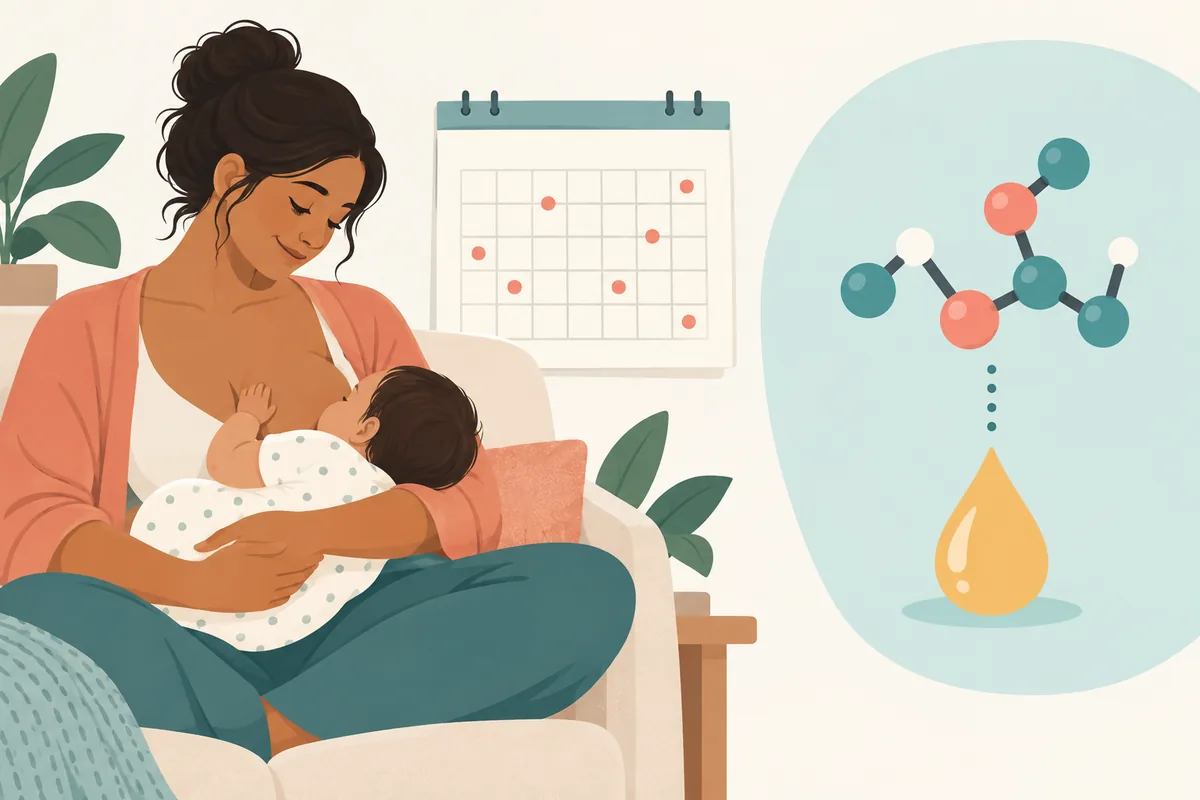
Breastfeeding does not make a urine pregnancy test positive by itself. Home tests look for human chorionic gonadotropin (hCG). An obstetrician-gynecologist interviewed by Romper explains that breastfeeding-related hormones are not the hCG signal a test detects. What matters is whether enough hCG is in the sample and whether you use and read the test as directed.
Symptoms, breast fullness, milk supply, or a missed period cannot confirm pregnancy. A correctly used test can help, but a negative taken too early may not settle the question. Discuss a positive result with a healthcare professional. If you have a medical condition, recent pregnancy, fertility treatment, or medicine question, ask a clinician or pharmacist to interpret it in context.
Why Pregnancy Test Timing Can Be Different After Birth
The first missed-period day is a common time to test, but that cue may be unavailable when periods have not returned or cycles are irregular. Guessing from a past bleed, app estimate, or feeding routine can feel more exact than it is. The test does not need a period date; it needs an appropriately timed urine sample.
The NHS gives a date-based alternative: if you do not know when your next period is due, test at least 21 days after the last unprotected sex. Count from the most recent possible exposure. An earlier test may not address a more recent date. If dates are unclear or you need advice about your circumstances, ask a clinician or sexual-health service.
| Your timing cue | A practical approach |
|---|---|
| Periods are regular and due | Test from the first day the period is missed, following the test instructions. |
| Periods have not returned or are unpredictable | Use the NHS date-based guidance: test at least 21 days after the last unprotected sex. |
| There were several possible dates | Consider whether the most recent date is at least 21 days ago; an earlier test may need repeating. |
| You cannot work out a date | Ask a healthcare professional for help choosing when to test. |
When Should You Take a Pregnancy Test While Nursing?
If your periods are regular, most home tests can be used from the first missed-period day. If you cannot predict your cycle, use the NHS guidance of at least 21 days after the last unprotected sex. This date-based rule is not related to how often you breastfeed and cannot guarantee what one individual test will show.
Some products allow earlier testing, but a negative before the recommended date may be too early to interpret. Read when your brand can be used and when its result window is valid. If the last possible exposure was less than 21 days ago, note the date and plan a test when that interval is reached; ask a clinician if the dates are complicated.
How to Use a Home Pregnancy Test
Tests differ in sample method and waiting time. Check the expiry date and read the leaflet before opening the package. The NHS says urine can be tested at any time of day; follow any additional instructions for your specific product. Use a timer so you read the result only during its stated window.
A mark that appears after the valid window may not be interpretable. If you are unsure whether a faint line appeared in time, treat the result as unclear and repeat with a new test or ask a clinician.
- Check the package. Confirm the test is in date and the wrapper is intact.
- Use the stated method. Follow the urine collection and exposure time exactly.
- Set a timer. Read the result only during the brand's valid window.
- Record the date. A note can help you plan a repeat when periods are irregular.
- Repeat an invalid test. A missing control or error display is not a negative result.
What Do Positive, Negative, and Invalid Results Mean?
A positive result in the manufacturer's reading window usually means the test detected hCG above its threshold. Follow the leaflet for faint lines or digital displays; line darkness is not a measure of pregnancy health. Contact a healthcare professional for next-step advice that considers your history and medicines. Breastfeeding does not make the result irrelevant.
A negative means hCG was not detected above that test's threshold in that sample at that time. It cannot rule out a test taken too early. If periods are absent, use the last possible exposure date rather than waiting for an unpredictable period. An invalid test has no interpretable result, so repeat with a new device.
| Result | What it can tell you | Next step |
|---|---|---|
| Positive in the valid window | The sample showed hCG at or above the test threshold. | Contact a healthcare professional for next steps. |
| Negative before a useful date | hCG was not detected above the threshold at that time. | Repeat at the recommended date if pregnancy is possible. |
| Negative at least 21 days after sex | This follows NHS timing guidance when the next period date is unknown. | If concern continues, repeat or seek professional advice. |
| Invalid or error display | The test produced no result you can interpret. | Use a new device and follow its instructions. |
What to Do After a Negative Pregnancy Test While Breastfeeding
Check whether you tested on a useful date. If it was before your expected period or before 21 days had passed since the last unprotected sex when your cycle date was unknown, plan a repeat instead of relying on the early negative. Use a new test and follow its reading window; repeating several times on the same day will not resolve an early timing question.
The NHS advises testing again after a few days when a period still has not arrived. Contact a GP if a second test is negative and your period remains absent. A clinician can review your dates and discuss whether another test or assessment is appropriate. Cycle symptoms cannot establish that a negative is wrong or identify why a period has not returned.
- Tested early? Repeat on the recommended date or at least 21 days after sex if your cycle date is unknown.
- Still no period after a second negative? Contact a GP or the appropriate local healthcare service.
- Unclear result? Use a new test or ask a professional to review it.
Pregnancy Test While Breastfeeding: FAQ
Sources and further reading
The timing guidance below comes from an official patient resource. The explanation that breastfeeding does not change the hCG signal is attributed to an OB-GYN interview; contact a clinician for advice specific to you.
The bottom line
A pregnancy test can be used while breastfeeding because it checks for hCG, not whether you are nursing. The harder part may be choosing a date when periods have not returned or are irregular. Use the expected-period date when it is known; otherwise, the NHS advises testing at least 21 days after the last unprotected sex. Follow the test instructions, repeat an early negative at the appropriate time, and ask a healthcare professional when results or next steps are uncertain.