Pregnancy Test After Embryo Transfer: When to Test
Understand the transfer-day timeline, the role of beta hCG, and what an early positive or negative result can and cannot tell you.
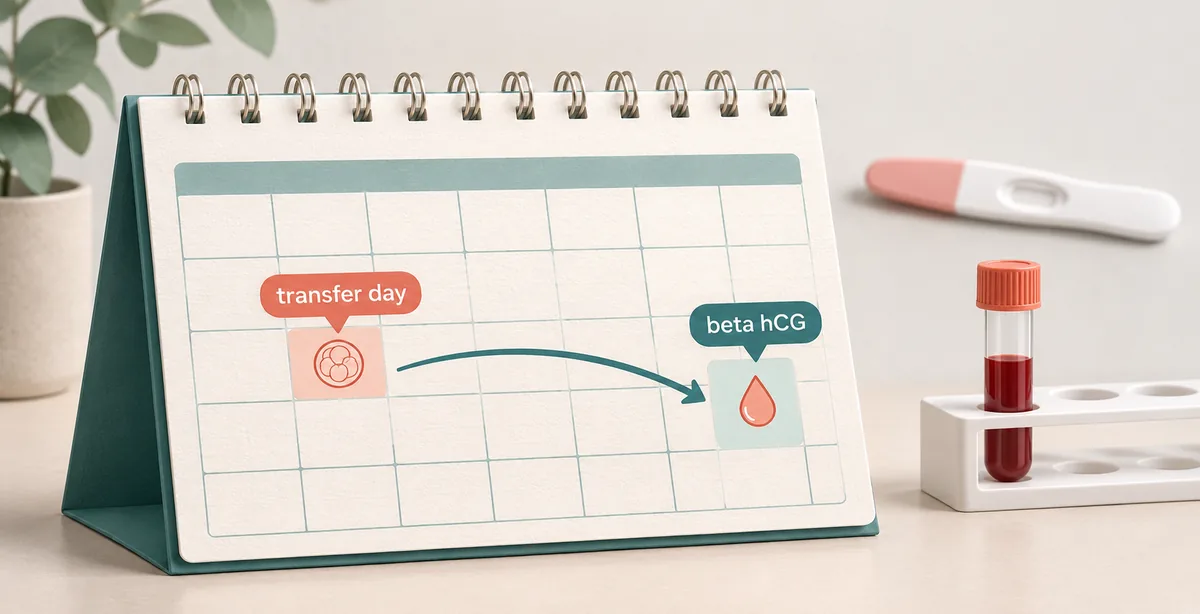
Quick answer: The safest date for a pregnancy test after embryo transfer is the date your fertility clinic gives you, usually about 9 to 14 days after transfer depending on embryo age and clinic protocol. A blood beta hCG test is more useful for treatment follow-up than an early home urine test. Testing too soon can be confusing because hCG may not have risen enough, or a recent trigger injection may still be detectable.
This guide starts the clock at embryo transfer, not at intercourse or an app's ovulation estimate. It explains the two-week wait, day-5 versus day-3 transfer timing, home testing, beta hCG, medication questions, and the symptoms that should never wait for a test result.
On this page
When Should You Take a Pregnancy Test After Embryo Transfer?
Use the test date supplied by your fertility clinic. Many programs arrange a quantitative blood beta hCG test roughly 9 to 14 days after transfer. The exact day depends on whether a day-3 embryo or day-5 blastocyst was transferred, whether the cycle was fresh or frozen, and how the clinic schedules follow-up. A clinic may count from egg collection, transfer, or a planned calendar date, so do not substitute a generic internet rule for the instruction on your paperwork.
The phrase pregnancy test after embryo transfer sounds simple, but the biology is not a stopwatch. Implantation can occur at different times, hCG rises after implantation, and urine tests have different detection thresholds. A negative home test on day 6 or day 7 does not reliably answer the question. A positive test may also need a blood result and a repeat value to show whether hCG is rising as expected.
The table below is a planning framework rather than a promise. If your clinic gives a different date, follow the clinic. Fertility teams may also ask you to test even when bleeding has started, because bleeding does not always explain what is happening.
| Timing after transfer | What may be happening | Practical plan |
|---|---|---|
| Days 1–5 | The embryo may be developing and implantation may not yet have produced detectable hCG. | Continue prescribed support and avoid using symptoms as a verdict. |
| Days 6–8 | Some early urine positives are possible, but many pregnancies will still test negative. | Treat an early negative as inconclusive and protect the clinic test date. |
| Days 9–11 | hCG may be detectable, especially after a blastocyst transfer, but protocols vary. | Only test at home if your clinic allows it and you can handle an uncertain result. |
| Days 12–14 | This is a common window for scheduled beta hCG or a more informative home test. | Use the clinic's collection and reporting instructions; ask when repeat testing is needed. |
| After the clinic result | A single value is interpreted with dates, medicines, symptoms, and sometimes a second value. | Keep every result and contact the fertility team for the next step. |
The key distinction
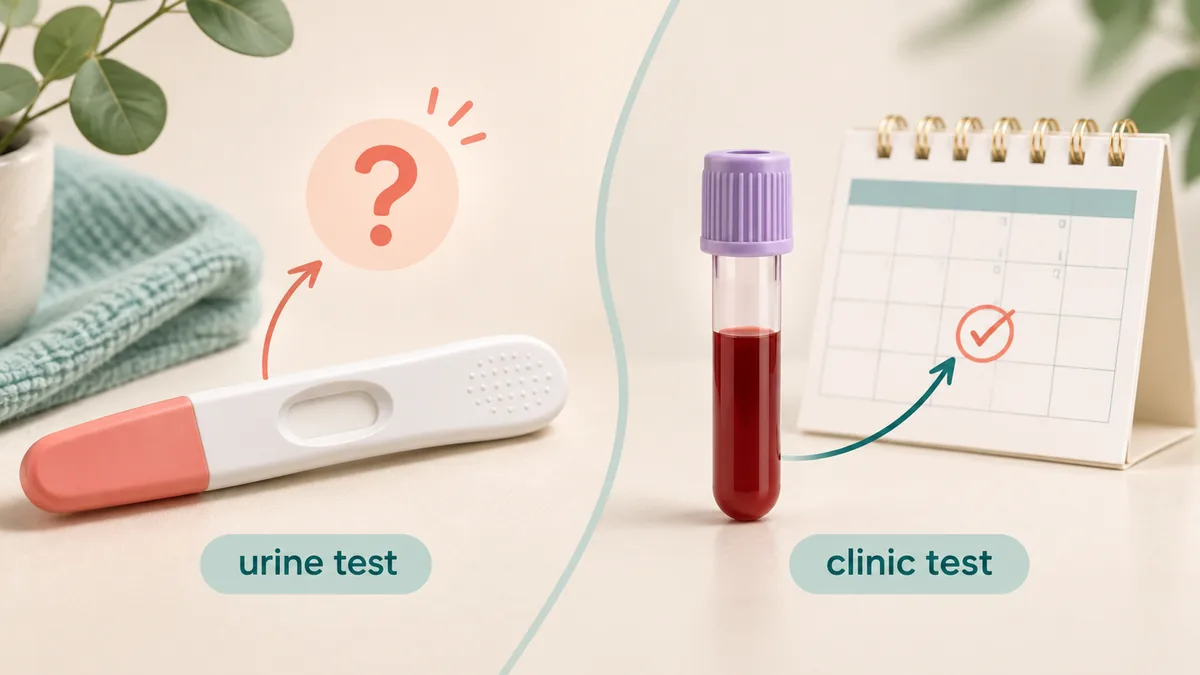
A home test can answer whether urine contains enough hCG for that brand at that moment. A clinic beta hCG result is a measured blood value interpreted in the context of embryo transfer and fertility medicines. They are related, but they are not interchangeable.
How the Transfer-to-Test Timeline Works
A day-5 blastocyst is already further along than a day-3 embryo when it is transferred, so the calendar can feel different even though both patients are told to wait for a clinic test. Ask your team what they mean by “day after transfer” and whether their written date already accounts for embryo age.
During the two-week wait, progesterone can cause breast tenderness, bloating, fatigue, constipation, discharge, or mild cramping. Those symptoms can occur with or without pregnancy. Likewise, no symptoms does not mean that implantation did not occur. Symptoms are not a substitute for hCG testing.
A recent hCG trigger injection is a separate timing issue. If your cycle used an hCG-containing trigger, residual medication can make an early home test look positive even when it is not measuring pregnancy-produced hCG. Ask the clinic how the trigger date affects your test plan instead of trying to interpret line darkness at home.
- Transfer date: Write it down and use the clinic's exact counting convention.
- Embryo age: Day-3 and day-5 transfers do not represent the same developmental day.
- Medication context: Progesterone supports the lining but does not confirm pregnancy; hCG trigger medication can confuse an early positive.
- Clinic protocol: The scheduled beta hCG date is the most useful anchor for treatment decisions.
Home Urine Test or Beta hCG Blood Test?
A home urine test is convenient, private, and easy to repeat. It is also affected by urine concentration, the brand's threshold, the time of day, and whether you read it inside the stated window. If you test early, first-morning urine may be more concentrated, but it cannot fix a test taken before enough hCG is present.
A quantitative beta hCG test measures hCG in blood and gives the clinic a number rather than only a line or a yes/no display. Fertility teams may repeat it after about 48 hours or on another schedule. The trend can be more informative than one isolated value, but only the treating team can interpret it for your protocol.
Do not compare a home line's darkness with another person's photo or with a different brand. Home tests are designed for threshold detection, not for tracking a precise rise. If you need a clinical answer, ask for the blood-test plan.
- Home urine test: Useful for a private early check, but timing and dilution can create false reassurance or confusion.
- Beta hCG: A measured blood result that fits the clinic's follow-up schedule.
- Repeat testing: A repeat may be planned when the first value is low, early, or unexpected.
- Medication: Continue prescribed medicines until the fertility team tells you otherwise.
- Check the date. Confirm that the day you plan to test matches the clinic's written instructions.
- Check the test. Use an unexpired test, follow the sample directions, and read only within the stated window.
- Record the result. Write down the date, time, brand, and any trigger medication so the clinic has context.
- Call as instructed. Send or report the result through the clinic's preferred channel instead of relying on an online calculator.
| Question | Why it matters |
|---|---|
| Can I test before beta hCG? | Only if the clinic says it is acceptable; an early result may not change the plan. |
| Does a faint line prove implantation? | A faint line within the valid window may reflect hCG, but it cannot establish location or progression. |
| Can I stop progesterone after a negative? | No. Wait for explicit instructions because timing and protocol vary. |
What Do Positive, Negative, and Unclear Results Mean?
A positive home test within the valid reading window means the sample contained hCG above that test's threshold. After IVF, the clinic may still request a blood test because the trigger injection, test timing, and need for repeat values matter. A positive result is a reason to contact the team, not a reason to change medicines without advice.
A negative result before the scheduled test may simply be too early. Even on the scheduled day, the clinic may want a quantitative result rather than a home line. If the result is negative, ask when to stop support, whether another test is needed, and what follow-up is available. Do not treat a negative home test as proof that symptoms are imaginary or that you caused a failure.
An invalid test has no reliable result. Missing control lines, a blank digital display, a flooded window, or reading after the stated time means you should use a fresh test or contact the clinic. A late shadow or grey mark is not a reason to keep re-reading a dried test.
- Positive: Report it and follow the beta hCG and scan plan; keep medicines unchanged until told otherwise.
- Negative early: Treat it as inconclusive and protect the scheduled clinic test.
- Negative on the clinic date: Ask the fertility team for the formal interpretation and next-cycle support.
- Invalid or unclear: Repeat with a new test only when useful, and do not infer a diagnosis from a photo.
| Result pattern | Next conversation with the clinic |
|---|---|
| Positive home test | When is blood beta hCG, and should it be repeated? |
| Negative before the planned date | Should I wait for the scheduled test or repeat at a specific time? |
| Bleeding with any result | How much bleeding is expected, and when should I be seen? |
| Unclear or invalid | Should I use another brand, come in for blood testing, or send a photo? |
Symptoms, Medicines, and Warning Signs
Mild cramping, light spotting, bloating, breast tenderness, tiredness, and emotional swings can occur during the two-week wait. Progesterone and the procedure itself can produce similar sensations. Some people have no symptoms at all. A symptom diary may help you communicate with the clinic, but it cannot predict the beta hCG result.
Keep taking progesterone, estrogen, aspirin, or other prescribed medicines exactly as directed unless the fertility team changes the plan. Avoid starting supplements, stopping prescriptions, or using someone else's medication to “help implantation.” Ask the prescriber about pain relief, exercise, sex, travel, and work restrictions because advice depends on your cycle and health history.
Contact the clinic promptly for heavy bleeding, increasing pelvic pain, fever, repeated vomiting, severe abdominal swelling, or a sudden change that worries you. Seek emergency care for severe one-sided pain, fainting, shoulder-tip pain, chest pain, or trouble breathing. These symptoms need assessment even if a home pregnancy test is negative or has not been taken.
- Usually non-specific: Tender breasts, fatigue, bloating, and mild cramps can come from medicines or early pregnancy.
- Call the clinic: Ask about bleeding, pain, fever, vomiting, medication questions, or a result that does not match the plan.
- Urgent care: Severe one-sided pain, fainting, shoulder pain, heavy bleeding, chest pain, or shortness of breath are urgent.
What to Have Ready When You Call the Clinic
A short, factual message helps the fertility team respond. Have your transfer date, embryo age if known, fresh or frozen cycle, trigger medication date, all current medicines, test brand and reading time, result, bleeding pattern, and symptoms ready. If you used a home test, keep the original package and do not send a heavily edited image.
Ask which result is the official result, when beta hCG will be checked, whether it will be repeated, when medicines change, and when an ultrasound is planned if positive. If the cycle is negative, ask about emotional support and the timing of a review. If the result is positive, ask what symptoms require same-day care and whether the clinic wants you to avoid any activity.
The clinic's answer may be different from advice in a general article because it reflects your embryo, medications, medical history, and local protocol. Write the instructions down and use the clinic's contact route for changes.
- Dates: Transfer, embryo age, trigger injection, planned beta hCG, and any home-test date.
- Medicines: Names, doses, last dose, and whether anything was missed or changed.
- Results: Brand, valid reading time, photo only if requested, and any bleeding or pain.
- Questions: Repeat testing, medication continuation, scan timing, and urgent-care thresholds.
FAQ About Pregnancy Tests After Embryo Transfer
Sources and Further Reading
This page was reviewed against patient-facing IVF guidance and a recent study. Read the original material and ask your own clinic for advice tailored to your cycle: Guy's and St Thomas' NHS Foundation Trust: IVF pregnancy test results, AJOG Global Reports study on testing after frozen embryo transfer, TFP Fertility: what to expect after embryo transfer.
The bottom line
The right pregnancy test after embryo transfer is the one timed to your fertility clinic's protocol. Home urine tests can be tempting during the two-week wait, but early negatives may be too early and early positives may be affected by an hCG trigger. Keep prescribed medicines, record dates and symptoms, report the result as instructed, and seek urgent care for severe pain, fainting, heavy bleeding, or breathing problems.