What Does One Line on a Pregnancy Test Mean?
One visible line is often a negative result—but only when it appears in the control area and the test was read correctly. The line location, test design, timing, and instructions determine what the result actually means.
Quick answer: if the single line appears at C or in the control window, the test usually worked and no pregnancy hormone was detected at that time. If the only line appears at T, or no control line appears, treat the result as invalid and repeat the test with a new device.
Do not decide from the number of lines alone. Brands use different windows, symbols, plus/minus formats, and digital displays. Compare the result with the diagram in the exact package instructions and only within the stated reading window.

On this page
What does one line on a pregnancy test mean?
On most line-based home pregnancy tests, one line in the control area means the test ran correctly and the result is negative at the time of testing. The control line confirms that urine moved through the test and the basic reaction occurred.
One line is not automatically a valid negative. If the control line is missing, the device cannot confirm that the test worked. A line only in the test area, a blank window, a smeared result, or a result read far outside the instructed time window should not be interpreted as a reliable positive or negative.
| What you see | Likely meaning | Best next step |
|---|---|---|
| One line at C/control | Usually a valid negative result | If testing early or your period is late, repeat in about 48 hours or follow the brand instructions |
| One line only at T/test | Invalid because the control line is absent | Discard it and repeat with a new test |
| No line | Invalid, incomplete flow, or device problem | Use a fresh test and follow the timing and urine directions |
| A second faint colored line within the read window | May be positive rather than a one-line result | Review the faint-line guide and confirm with a repeat test or clinician |
| A colorless or grey mark after the read window | May be an evaporation or indent line | Ignore late changes and interpret only within the instructed window |
First identify the control line and test line
Look for the small C and T markings, the package diagram, or separate control and result windows. C means control; T means test. On some devices the control line is in a smaller window, while the result appears in a larger window. The exact layout matters more than whether the line is on the left or right.
A control line does not say whether you are pregnant. It says the test processed the sample. The test line reacts when hCG is detected above that test's threshold. Therefore, C alone usually means negative; C plus a colored T line within the reading window may mean positive; T without C is invalid.
- Use the exact leaflet. Do not rely on a picture from another brand because line positions and symbols differ.
- Check color and timing. A genuine result line usually develops during the stated window; late shadows are less reliable.
- Photograph promptly. If you want a record, take a clear photo within the valid reading time rather than after the test dries.
Why the reading time changes the meaning
Home tests are designed to be read during a specific interval, often a few minutes after exposure to urine. Reading too soon can miss a developing line. Reading too late can reveal evaporation marks, dried dye, or background shadows that were not part of the valid result.
Set a timer and use the range printed by the manufacturer. Do not keep rechecking the device hours later. If you missed the reading window, the safest interpretation is uncertain, not positive or negative; repeat with a new test.
What to do after a one-line result
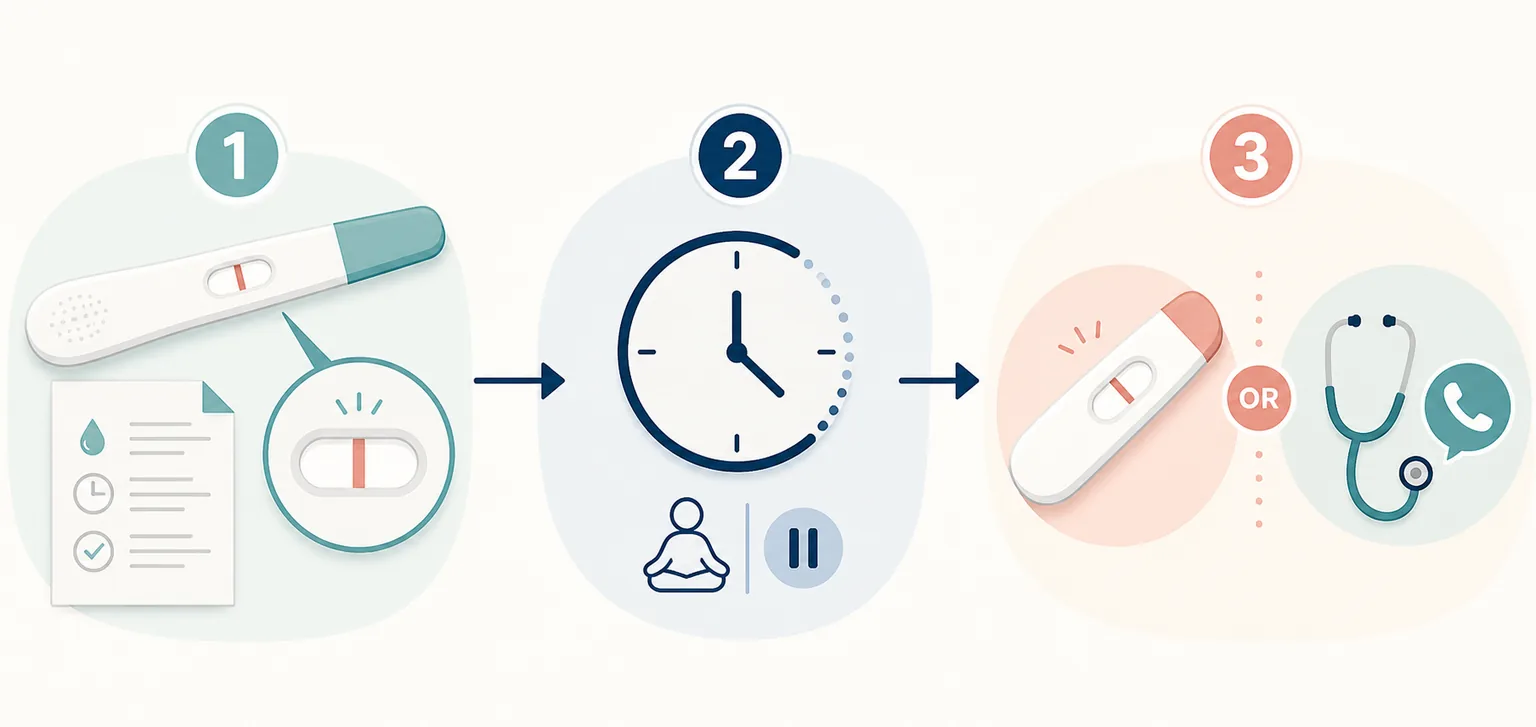
Your next step depends on whether the test was valid and when you tested. A valid control-only result is more reassuring after a missed period than several days before the expected period, because hCG may still be below the detection threshold early on.
- Confirm the control line. Match the single line to C/control or the control window in the instructions.
- Check the clock. Use only the result seen inside the brand's reading window.
- Review test conditions. Check expiration, storage, urine amount, and whether excess fluid or diluted urine could affect the test.
- Retest when appropriate. If you tested early, symptoms continue, or your period is late, use a new test in about 48 hours, preferably with concentrated urine and the same careful timing.
- Contact a clinician when needed. Ask about urine or blood testing if results remain unclear, cycles are very irregular, or symptoms and tests do not agree.
When one control line can still be a false negative
A valid negative test means hCG was not detected above the device threshold in that sample. It does not prove that pregnancy is impossible. Testing before or near the expected period, ovulating later than estimated, using very diluted urine, or not following the instructions can all produce a negative result before hCG becomes detectable.
If pregnancy is possible and menstruation has not started, repeat testing according to the package directions. A roughly 48-hour interval is often practical early in pregnancy because hCG can rise over time, but individual patterns vary. Do not use line darkness to estimate gestational age or pregnancy health.
Not every pregnancy test uses C and T lines
Midstream sticks, cassette tests, strip tests, plus/minus tests, and digital tests display results differently. A plus/minus device may require a control indicator plus a symbol in another window. A digital test may show words or an error icon instead of lines. Strip tests may have printed orientation marks only on the wrapper.
This guide applies to line-based tests only. If your device uses a symbol or screen, follow its specific instruction leaflet. Never open a digital test and interpret the internal strip; internal lines are not intended as the consumer result and can be misleading.
Frequently asked questions
Medical sources
For general guidance on home pregnancy testing, see the U.S. Food and Drug Administration, U.S. Office on Women's Health, MedlinePlus pregnancy test overview. Always follow the instructions supplied with your specific test.
Bottom line
One line usually means negative only when it is the control line, appears within the valid reading window, and the test was used correctly. A missing control line makes the test invalid. If you tested early, your period remains late, or symptoms and results do not agree, repeat with a fresh test or ask a clinician about confirmation.