Can You Take a Pregnancy Test at Night? Accuracy, Timing, and What to Do
Yes—but your cycle timing and urine concentration affect how easy an evening result is to interpret.
Quick answer: Yes. You can take a pregnancy test at night, especially on or after the day your period is expected. Night testing is less ideal when you are testing very early or have had a lot to drink, because diluted urine can make a negative result less informative.
This guide explains can you take a pregnancy test at night in plain language, including when first-morning urine is helpful, how to reduce avoidable testing errors, and what to do if the result is negative or unclear.

On this page
Short answer: yes, but timing matters
A home pregnancy test can be used at night. The test is looking for human chorionic gonadotropin, usually called hCG, in urine; it is not automatically invalid because the sample was collected in the evening. The more important questions are how far along you may be, how concentrated the urine is, and whether you follow that test's instructions.
After the expected period, an evening sample may give useful information for many people. If you are testing before the expected period, hCG may still be low. In that situation, first-morning urine is often a better choice because it is usually more concentrated after several hours without drinking.
A negative nighttime result therefore needs context. It can be reassuring when the timing is appropriate and the test was used correctly, but it is not a guarantee that pregnancy is impossible when testing is early, the urine is dilute, or the cycle date is uncertain.
- Night testing can work. It is a reasonable option when you need to test in the evening and the test is used within its instructions.
- Morning urine can help early testing. It may contain a higher concentration of hCG when the hormone is still near the test's detection threshold.
- A negative is not always final. Early testing, excessive fluids, incorrect use, or a late ovulation date can all make a negative result harder to interpret.
- The label still controls. Different tests have different sample, timing, and reading-window instructions, so follow the package rather than a generic rule.
For a broader explanation of home-test reliability, read the pregnancy test accuracy guide .
When a pregnancy test at night is reasonable
If you cannot wait until morning, taking the test at night is not automatically a mistake. A result is easier to use when you are testing on or after the day your period was expected, your urine has not been heavily diluted, and you can read the test in the manufacturer's stated window.
The table below is a practical way to decide whether an evening test is likely to answer your question or whether waiting and repeating would give you a clearer result. It is not a substitute for the instructions supplied with your test.
| Situation | How to interpret it | Practical choice |
|---|---|---|
| On or after the expected period | An evening sample can be useful when the test is used correctly. | Test at night if needed; arrange follow-up for a positive result. |
| Before the expected period | A negative may simply be too early for urine hCG to reach the detection threshold. | Use first-morning urine or plan a repeat test at the appropriate time. |
| You drank a lot of fluid | The sample may be diluted, which can make a low hCG signal harder to detect. | Avoid overhydrating, wait if practical, or repeat with a more concentrated sample. |
| Your cycle date is uncertain | Counting from sex or symptoms cannot identify the exact ovulation or implantation date. | Use a date tool for planning only and ask a clinician if uncertainty continues. |
A pregnancy test calculator can organize possible testing dates, but it cannot diagnose pregnancy or account for every cycle.
When first-morning urine is a better choice
First-morning urine is not a universal requirement. It is mainly useful when you are testing early, when a previous result was very faint or negative, or when you want to reduce the effect of drinks taken shortly before testing. Several hours of urine storage can make the sample more concentrated, although individual hydration and cycle timing still matter.
If you are already past the expected period, a correctly used test may work at other times of day. The distinction is practical rather than magical: morning can improve the odds of detecting a small amount of hCG, while later testing can still be informative when hCG is higher.
Do not force yourself to wait until morning if you have urgent symptoms. Pain, heavy bleeding, fainting, or shoulder pain need medical assessment regardless of the clock or what a home test appears to show.
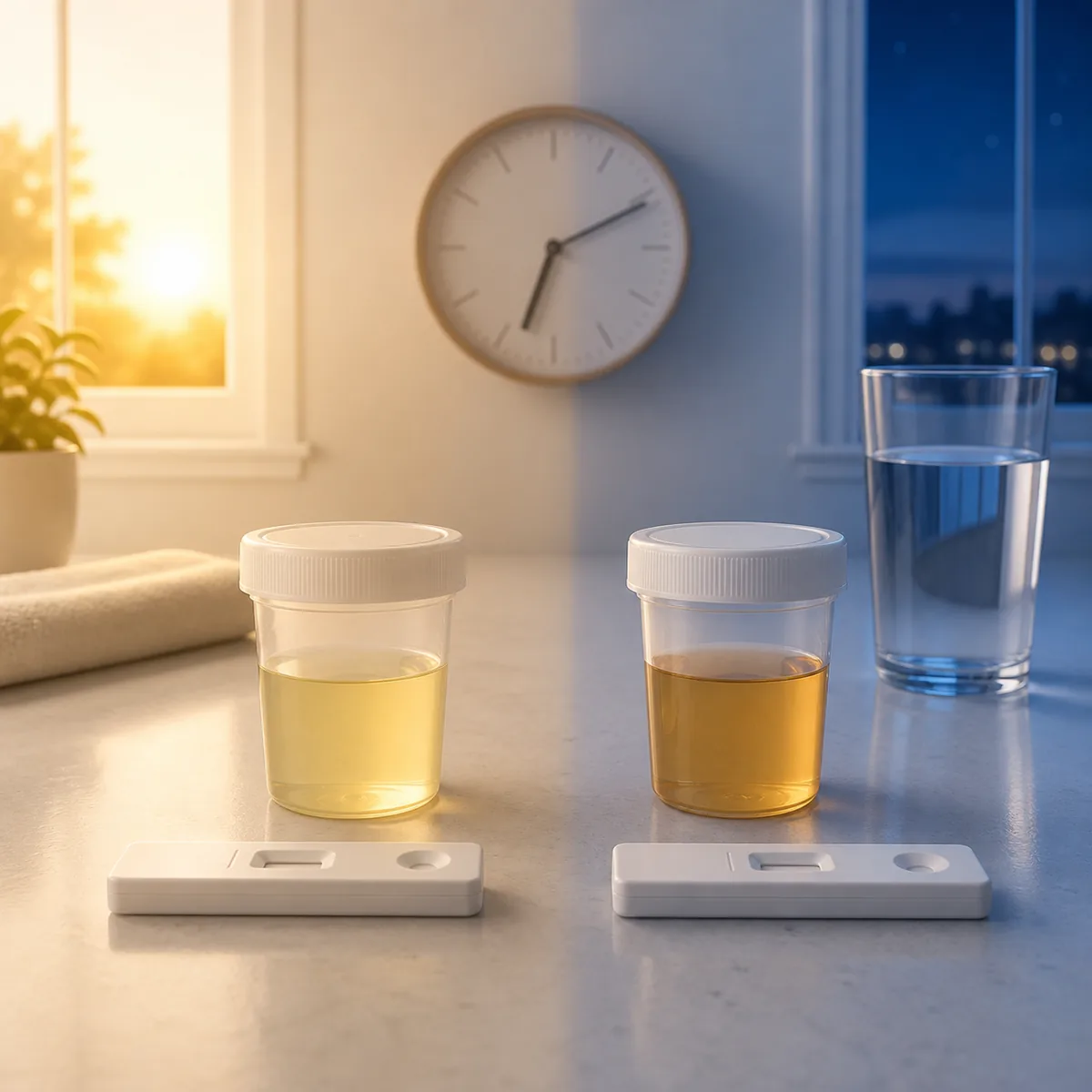
- Testing before the expected period: first-morning urine may make an early result easier to detect.
- A faint or uncertain result: repeat with a fresh test at an appropriate time instead of re-reading a dried strip.
- A lot of evening fluids: waiting for a less diluted sample can be more useful than treating a negative as final.
- A late period with repeated negatives: contact a healthcare professional to discuss timing and other possible causes.
How to make an evening test more reliable
You cannot control the timing of ovulation or implantation, but you can reduce avoidable testing errors. Treat the test like a small measurement: check the conditions, follow the directions, and record what you actually observed.
1. Check the date and packaging
Use an unexpired test with intact packaging. Heat, moisture, damage, or an opened packet can affect how the test performs.
2. Avoid deliberately overdrinking
Normal hydration is fine, but drinking a large amount immediately before testing can dilute urine. Do not dehydrate yourself to chase a stronger result.
3. Use the stated sample method
Whether the test is used in the stream or with a collection cup, follow the instructions for sample amount, contact time, and orientation.
4. Set a timer
Read the result only in the stated window. A mark that appears hours later may be a drying artifact and should not be treated as a new result.
5. Keep the photo in the valid window
If you want a visual record or use a photo checker, take the picture while the result is valid and remove personal information from the frame.
6. Plan the next step before testing
If the result is negative but the test was early, decide when you will repeat it. If it is positive, arrange professional follow-up rather than relying on a photo alone.
For control lines, test lines, and reading windows, use the how to read a pregnancy test guide .
How to read a nighttime result
Start with the control line or control indicator. If it is missing, the test is invalid and cannot be called positive or negative. If the control is present, interpret the test indicator only within the manufacturer's reading window and according to that test's own diagram.
A colored line that appears within the valid window may represent detected hCG, even if it is faint. A mark that appears only after the window, has no dye, or changes as the strip dries should not be treated as a confirmed positive. The time of day does not turn an invalid or late mark into a valid result.
A clear negative result is most useful when the test was not too early and the sample was not overly diluted. If those conditions are uncertain, repeat testing at an appropriate time instead of repeatedly editing or enlarging the same photo.
| Visible situation | What it may mean | What to do |
|---|---|---|
| Control present; test indicator appears within the window | The test may have detected hCG. | Arrange healthcare follow-up, especially if the result is unexpected or important. |
| Control present; no test indicator | The test is negative at that time, but timing and dilution still matter. | Repeat if testing was early or the period remains absent. |
| No control indicator | The test is invalid and did not answer the question. | Use a new, unexpired test and follow the directions carefully. |
| Mark appears only after the reading window | It may be a drying or evaporation artifact. | Do not rely on the late mark; repeat with a fresh test if needed. |
When to repeat the test or seek medical care
Repeat testing is reasonable when the evening test was taken before the expected period, after a large amount of fluid, with uncertain instructions, or when the result was difficult to read. Use a new test rather than reusing or reinterpreting a dried strip. Follow the package timing or ask a clinician when a repeat is appropriate.
If your period remains absent despite repeated negative tests, contact a healthcare professional. They can review cycle timing, medicines, symptoms, and whether a urine or blood test is appropriate. A positive home test should also be followed up for confirmation and care planning.
- Repeat when: the test was early, the sample may have been dilute, the instructions were not followed, or the result was unclear.
- Contact a clinician when: your period is late after repeated negatives, results keep changing, or you need advice about medicines or symptoms.
- Seek urgent care when: you have severe or one-sided abdominal pain, fainting, shoulder pain, or heavy bleeding.
- Keep a record of: the test date, reading window, cycle timing, symptoms, and relevant hCG-containing medicines.
For more detail on why a negative can be too early or otherwise misleading, read the false-negative pregnancy test guide .
Can an AI photo checker confirm the result?
A clear photo can help you inspect whether the control line is visible, whether the image is blurry, and whether a mark appears inside the reading window. It can also help you explain what you saw to a healthcare professional. That is visual support, not a hormone measurement.
A photo cannot tell when ovulation or implantation happened, how diluted the urine was, whether the test was expired, or whether a medicine affected hCG. It cannot safely override the package instructions or clinical advice, and it cannot turn an out-of-window mark into a confirmed result.
If you use this site's tool, upload a well-lit photo only when you are comfortable doing so and remove names, addresses, and other personal information. Use the result to organize observations, then rely on correctly timed testing or professional confirmation.
You can use the AI pregnancy test checker to review visible line placement and image quality, but it is not a diagnostic test.
Pregnancy test at night FAQ
Medical references
For medical context about home-test timing, urine samples, and limitations, consult these patient-facing sources and the instructions supplied with your own test.
The bottom line
You can take a pregnancy test at night. Evening testing is more useful on or after the expected period and when urine has not been heavily diluted. First-morning urine can help when testing early, but no time of day replaces correct use, a valid reading window, repeat testing when appropriate, or professional care when symptoms or uncertainty persist.